
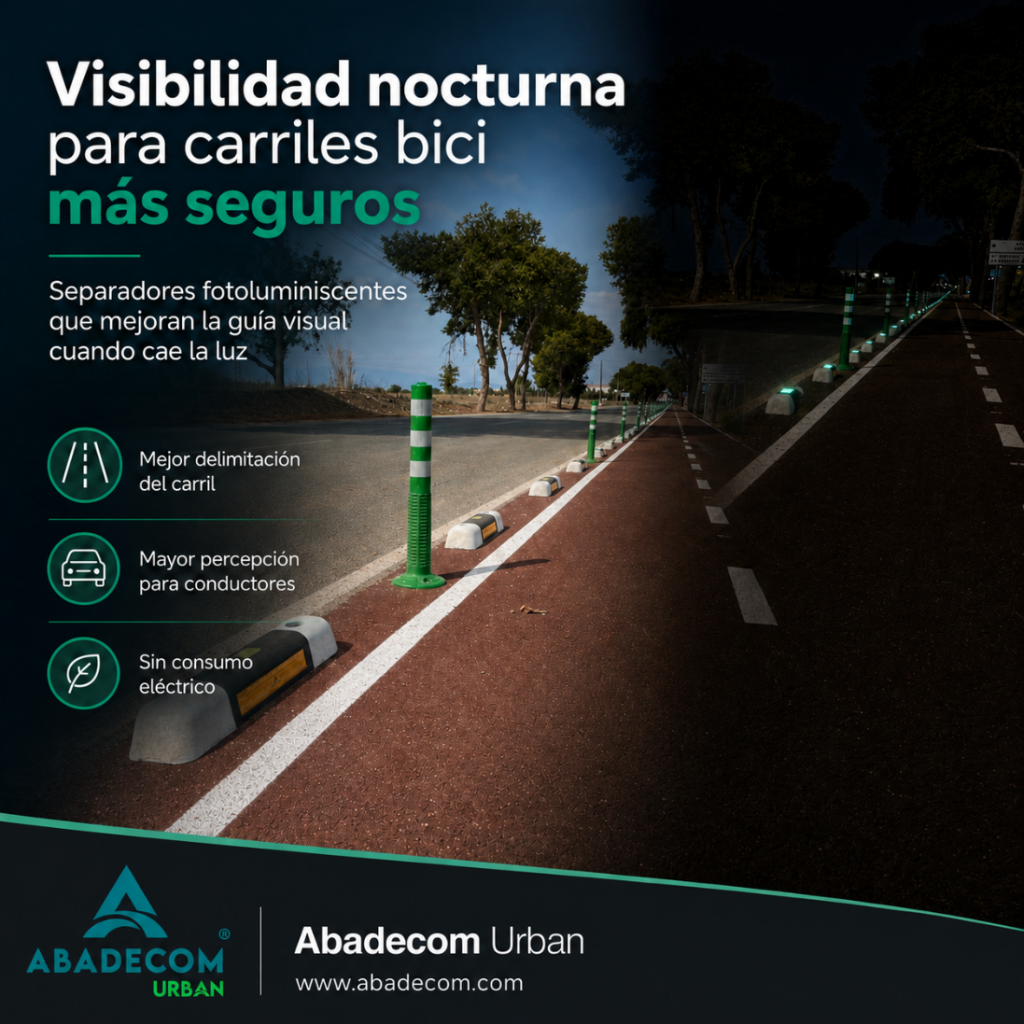
The safety of a cycle lane does not depend solely on the existence of a reserved route for cyclists. It also depends on how it is demarcated, the visibility it offers and the resistance of the elements installed on the road.
In many urban environments, some cycle lane separators do not perform their function well because they deteriorate quickly, are poorly visible at night or are not prepared to withstand the daily use of the road. When this happens, the cycle lane loses its effectiveness and the safety of cyclists, pedestrians and drivers can be compromised.
At Abadecom we have developed a photoluminescent cycle lane separator and a reflective product designed specifically to tackle these issues: to improve night-time visibility, enhance road safety and offer a durable solution made from recycled 100% plastic.
The problem: dividers that can't be seen when they are needed most
One of the main flaws of some cycle lane separators is their low visibility in low-light conditions.
During the day they can clearly delimit the lane, but at night, in poorly lit areas, in the rain or on urban stretches with low visibility, they can go unnoticed. This increases the risk of cycle lane encroachment, collisions, sudden manoeuvres or confusion among the various road users.
Visibility must not rely solely on public lighting. A good separator should help mark the lane even when lighting conditions are less than ideal.
Abadecom's photoluminescent cycle lane separator incorporates a high-performance photoluminescent piece that charges with sunlight or artificial light. Once charged, it maintains its luminescence for more than 12 hours in dark conditions.
This means that the separator can provide sustained nighttime visibility without the need for an electrical connection, wiring or its own energy consumption. Photoluminescence does not replace good road planning, but it does add an extra layer of perception and guidance. The lane is better identified, the separator is detected earlier and the surroundings are clearer for cyclists, drivers and pedestrians.
Durability for demanding urban environments
A cycle lane separator is exposed to impacts, scuffs, water, dirt, solar radiation, temperature changes and road maintenance. That is why material strength is key.
Abadecom’s photoluminescent cycle lane marker is made from recycled 100% PVC and recyclable 100% PVC. This material offers high resistance to abrasion, UV rays and impact, as well as requiring minimal maintenance
Our separator is made from recycled 100% plastic and recyclable 100% plastic, contributing to the circular economy and the reuse of plastic waste. Furthermore, according to the product’s environmental information, each unit prevents the emission of 22.75 kg of CO₂ into the atmosphere.
This allows local authorities, construction companies, engineering firms and public works managers to incorporate more sustainable solutions without compromising safety or durability.
A solution designed for safer cities
Cycle lane separators fail when they are not visible, when they deteriorate quickly or when they do not provide clear protection for the cycling space.
Abadecom’s photoluminescent cycle lane marker meets these needs with a comprehensive solution: sustained night-time visibility without the need for electricity, enhanced road safety, high durability, simple installation and manufacture using recycled 100% plastic.
At a time when cities are looking for safer, more sustainable and efficient infrastructure, this type of solution makes it possible to improve cycling mobility using technical, environmental and safety criteria.
At Abadecom We work to make urban spaces safer, more visible and more sustainable. Our photoluminescent cycle lane separator is a solution designed to respond to current mobility challenges: better protecting cyclists, improving night-time visibility of the road and reducing the environmental impact of urban infrastructure.
Because a safe cycle lane doesn't just start with a line on the ground. It starts with visible, robust separation designed to last.