
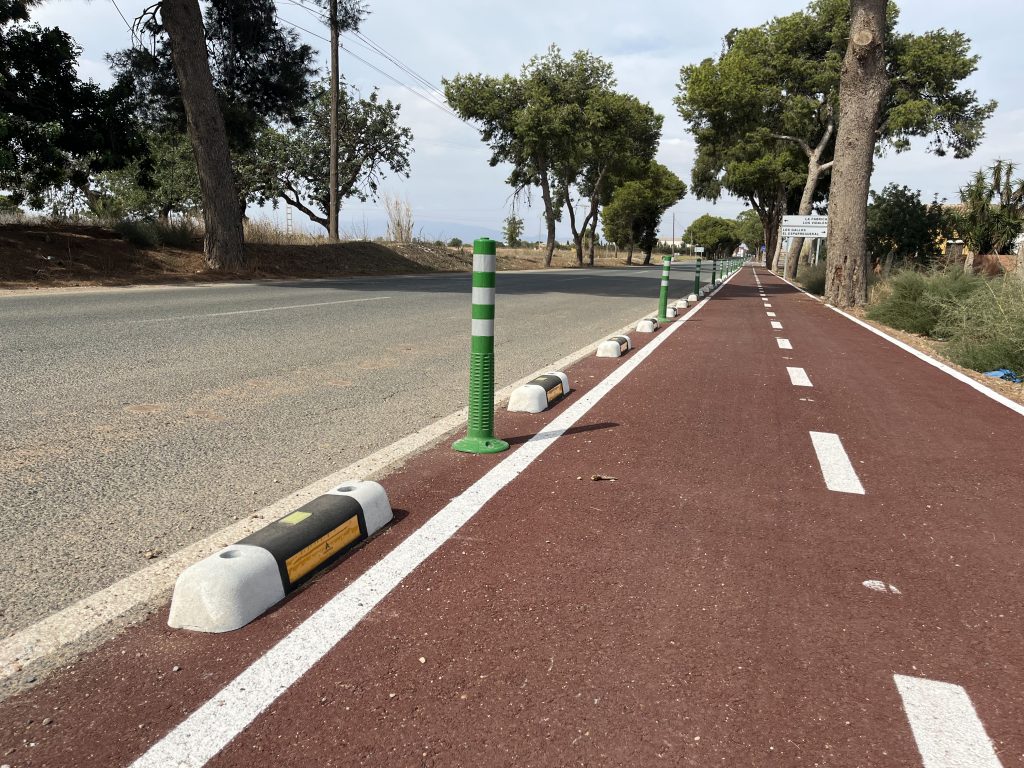
Urban mobility is changing. More and more cities are opting for cycle lanes, traffic-calmed zones and better-organised spaces for pedestrians, cyclists and vehicles. But for cycling infrastructure to truly work, painting a line on the ground is not enough: it is necessary to delimit, protect and make the route visible at any time of day.
In this context, the Abadecom Urban photoluminescent and reflective cycle lane separator it presents itself as an innovative solution to improve road safety, enhance nighttime visibility and contribute to more sustainable mobility.
A solution designed for safer cities
The cycle lane has become a key element within new city models. It allows for the promotion of more sustainable travel, reduces the presence of private vehicles and improves coexistence among different road users.
However, many cycle lanes need a clear physical separation to prevent lane incursions, improve the perception of space and increase the safety of those travelling by bicycle or scooter.
Abadecom Urban’s photoluminescent cycle lane separator is designed precisely for that: clearly, robustly and permanently demarcate spaces intended for cycling mobility.
Photoluminescence: visibility without electricity consumption
One of the differentiating features of this separator is its photoluminescent piece integrated into the upper part. This device is activated by sunlight or artificial light and, once charged, remains visible for more than 12 hours in dark conditions or in poorly lit areas.
This is a major advantage in urban areas where visibility can be reduced at dusk, at difficult junctions, access points, peri-urban areas or sections with limited lighting.
Furthermore, the separator combines photoluminescence with reflective elements. Its white reflective parts allow detection from over 400 metres away, enhancing visibility for drivers as well as cyclists and pedestrians.
Made from recycled and recyclable 100% PVC
Sustainability is another strong point of the Abadecom Urban divider. It is manufactured with Recycled PVC 100% and recyclable PVC 100%, a strong, durable material suitable for withstanding the demands of the urban environment.
Compared to other alternatives, recycled PVC offers high resistance to abrasion, impacts and ultraviolet radiation. It is also an easy-to-clean material, does not splinter and requires minimal maintenance, making it a particularly attractive option for local authorities, public works and urban mobility projects.
In addition, each installed unit helps prevent the emission of 22.75 kg of CO₂ into the atmosphere, reinforcing its value within projects linked to the circular economy and urban sustainability.
Quick installation and reduced maintenance
The photoluminescent cycle lane separator from Abadecom Urban is designed to facilitate its installation in different types of projects. It features an anchoring screw fixing system, which allows for quick, clean and simple assembly without the need for complex construction work.
Her measurements are 700 × 160 × 100 mm and has an approximate weight of 6.5 kg, which makes it easier to handle and place in urban sections, peri-urban areas, segregated cycle lanes, road improvement works or traffic reorganisation projects.
Abadecom Urban: innovation in the service of sustainable mobility
At Abadecom Urban, we work to offer solutions that unite security, innovation, sustainability and durability. Our photoluminescent cycle lane separator responds to a real need in modern-day cities: to create safer, more visible and more environmentally friendly infrastructure.
Choosing to invest in these types of separators means investing in a more orderly, efficient and future-proof urban mobility.
Do you want to improve the safety of your cycle lanes?
Whether you are a local authority, construction company, engineering firm, architecture practice or urban mobility officer, at Abadecom we can help you find the most suitable solution for your project.
Request information about our photoluminescent cycle lane separator and discover how to transform cycling infrastructure into a safer, more visible and sustainable space.