
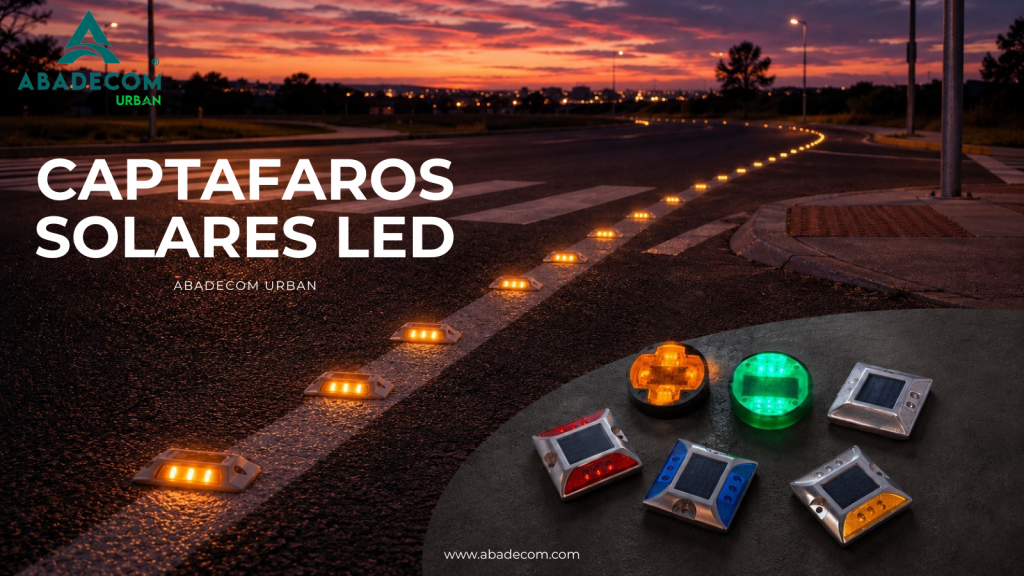
Night-time visibility remains one of the greatest challenges in road safety. Although many roads have horizontal road markings, reflective markers and traditional cat's eyes, there are still sections where driving at night is uncomfortable, unsafe or confusing for road users.
In this article we analyse what night-time visibility problems roads continue to have despite using traditional road studs and why solar LED road studs Abadecom they present themselves as a more visible, autonomous and efficient alternative to enhance road safety.
Traditional road studs are reflective elements. Their function is to return part of the light they receive from vehicle headlights, helping the driver to identify the layout of the road.
The problem is that they do not emit their own light. Therefore, their effectiveness depends on several external factors: the angle of incidence of the light, the distance the driver is at... When any of these factors fail, the road stud can lose part of its usefulness, especially at night or in low visibility situations.
LED solar road studs: active signage versus passive signage
The main difference between a traditional road stud and a solar LED road stud is that the former reflects the light it receives, while the latter emits its own light.
Abadecom's LED solar road studs incorporate solar-powered luminous technology. During the day, they charge via their solar panel and, at dusk, they activate automatically to improve road visibility.
This active signage allows the driver to perceive the road layout, the road edges or hazard points much earlier, even in areas with poor lighting or low-visibility conditions.
Where to install LED solar road studs?
Abadecom's LED solar road studs can be installed in multiple environments where it is necessary to enhance nighttime visibility:
- Roads with dangerous bends.
- Roundabouts and circulatory islands.
- Access to housing estates, industrial estates or car parks.
- Pedestrian crossings.
- School or residential zones.
- Kerbs.
- Unlit rural stretches.
- Urban and peri-urban roads.
Abadecom's LED solar road studs offer an active, autonomous and sustainable solution to improve the visual perception of the road at night. By emitting their own light, they help drivers, pedestrians and road users to better identify their surroundings and anticipate changes in trajectory.
The question is not whether traditional road studs are useful, but whether they are sufficient in all scenarios. The reality is that many roads continue to present night-time visibility problems despite having conventional reflective signage.
Therefore, solutions such as Abadecom's LED solar road studs make it possible to move towards more visible, efficient road signage that is adapted to current safety needs on roads, in urban environments and in poorly lit areas.
Frequently asked questions
What problem do traditional road studs have at night?
The main problem is that they rely on the vehicle's headlight beam. If there is rain, fog, dirt, wear or poor alignment, their visibility can be reduced.
Do LED solar road studs replace traditional ones?
They can replace or complement them, especially in areas where more visible, active and autonomous signage is needed.
Where are solar LED road studs most useful?
They are especially useful on bends, roundabouts, junctions, pedestrian crossings, road edges, access points and poorly lit areas.
Do solar LED road studs need an electrical connection?
No. They run on solar power, so they don't require wiring or a mains electricity connection.
Why choose Abadecom LED solar road studs?
Because they offer an active, autonomous and sustainable signage solution to enhance road safety at critical points and improve night-time visibility.