
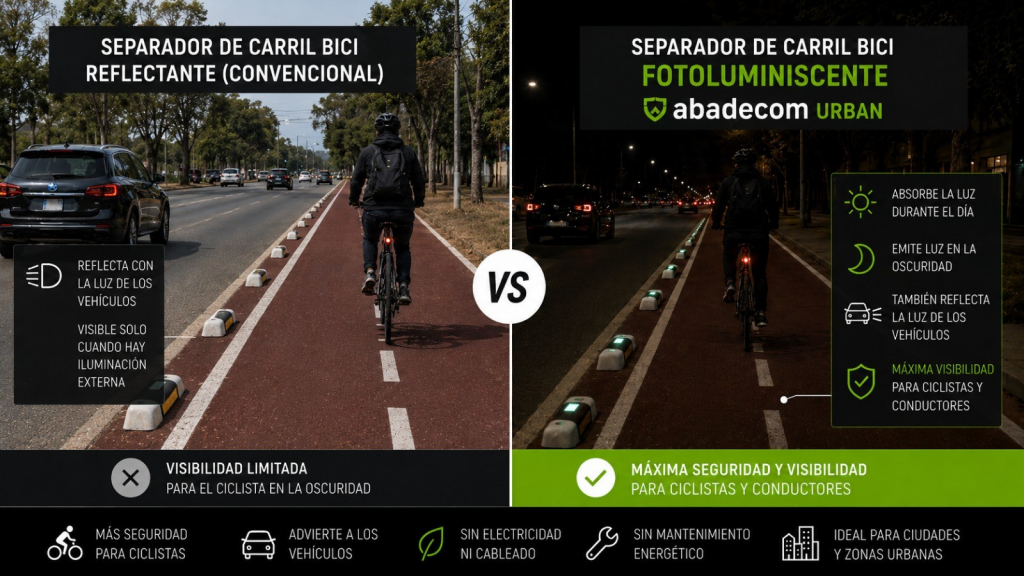
Security in the urban cycling infrastructure it depends to a large extent on the correct delimitation of the space designated for bicycles, scooters and other users of the cycle path. In urban and interurban areas, roadworks or poorly lit environments, cycle lane separators fulfil an essential function: clearly marking the boundary between the cycle route and motorised traffic.
Among the available solutions, the photoluminescent cycle lane separators they represent an evolution compared to conventional reflective delineators, as they combine two key road-marking technologies: the reflectance and the photoluminescence.
What is the difference between a reflective marker and a photoluminescent one?
The reflective separators they are designed to reflect light back when they receive direct illumination, for example, that from vehicle headlights. This feature is very useful for drivers, as it makes it possible to identify from a certain distance the existence of an adjacent lane that must not be encroached upon. However, their effectiveness depends on an external light source. If there are no headlights, street lighting or sufficient illumination, the divider loses a large part of its visibility.
Meanwhile, a photoluminescent separator absorbs light during the day or when there is ambient lighting and subsequently emits it in dark or low-light conditions. This helps to improve night-time visibility without the need for electricity, wiring, or energy maintenance.
The main advantage: photoluminescent and also reflective
The main difference with Abadecom's photoluminescent cycle lane separator is that it doesn't replace reflective technology, but rather complements it.
That is to say, the spacer offers a dual function:
- Photoluminescent function, which helps the cyclist or cycle lane user to identify the lane layout in conditions of darkness, dim light or low illumination.
- Reflective function, which warns motor vehicles of the existence of an adjacent cycle lane that they must not enter.
This combination makes it possible to comply with the two most important road marking techniques: passive luminous signalling via photoluminescence and reflective signalling for motor traffic.
Regarding cyclist road safety, visibility is crucial. A poorly demarcated cycle lane can lead to involuntary incursions by vehicles, unsafe manoeuvres or hazardous situations for vulnerable road users.
The photoluminescent cycle lane separators they help to reduce these risks because they make the infrastructure more visible from two different perspectives:
For the cyclist, the separator marks the path of the cycle lane even when lighting is limited. This aids navigation, particularly on night-time stretches, in tunnels, underpasses, roadworks areas or zones with insufficient public lighting.
For the driver, the reflective part acts as a visual warning when the headlights hit the separator, clearly indicating that there is a reserved lane which must be respected.
Reflective lane separators: useful, but limited
The reflective separators they continue to be a valid solution for warning motor traffic. Their main strength is that they respond very well when they receive direct light from vehicles.
However, in environments where cyclists also need to be guided, reflectivity alone may prove insufficient. The cycle path user does not always have a powerful light source or one directed towards the separator. Therefore, photoluminescence adds an extra layer of visual safety. The most complete solution is not to choose between reflective or photoluminescent, but to integrate both properties into a single delineation element.
Applications in urban cycling infrastructure
Photoluminescent cycle lane separators are especially recommended in:
- Urban cycle lanes with nearby motor traffic.
- Areas with low nocturnal lighting.
- Roadworks or temporary diversions.
- Access to roundabouts, junctions and accident blackspots.
- Cycle routes alongside vehicular roadways.
- Cycle routes in parks, promenades or peri-urban areas.
- Spaces where it is sought to improve signage without installing electricity.
In all these cases, the combination of photoluminescence and reflectance contributes to a clearer, safer and more efficient urban cycling infrastructure.
Abadecom's photoluminescent cycle lane separator offers a differential advantage over conventional reflective separators: as well as being photoluminescent, it is also reflective.
This dual technology makes it possible to improve nighttime visibility of the cycle lane for cyclists while, at the same time, warning drivers of motor vehicles of the existence of a cycle route that they must not invade.
Therefore, photoluminescent cycle lane separators are an effective solution to enhance cyclist road safety, optimise luminous signage without electricity, and move towards safer and more sustainable urban mobility.